Fluorescence microscopy
A bright fluorochrome that binds DNA. Used in acriflavine–Schiff (fluorescent Feulgen) staining, and to label nuclei and cell walls in plant and fungal tissue.
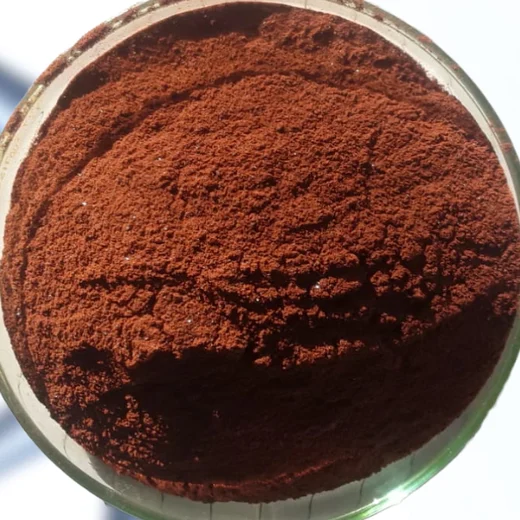
Histology · cytology · plant science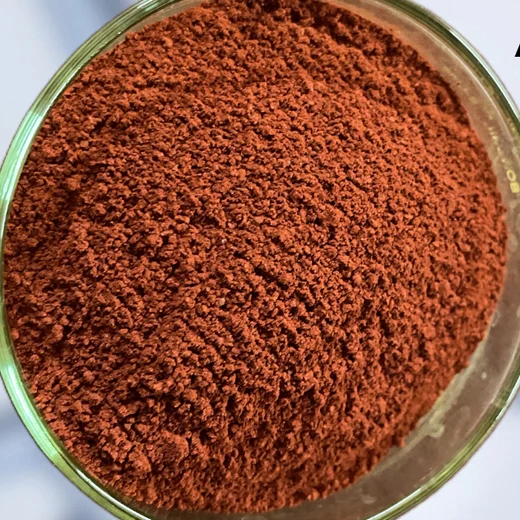 Powder · orange to dark red
Also known as Acriflavine HCl, Acriflavinium chloride and Trypaflavine
A strongly fluorescent acridine dye for microscopy, microbiology media, genetics research and aquaculture, tested batch by batch.
Acriflavine Hydrochloride is an orange to deep-red acridine dye. It is a blend of two closely related acridines, 3,6-diamino-10-methylacridinium chloride and 3,6-diaminoacridine (proflavine), supplied as their hydrochloride salts.
It dissolves readily in water, about one part in three at 20 °C, to give an intense yellow solution with a bright green fluorescence. Acriflavine binds strongly to nucleic acids, which is why laboratories have used it for decades as a fluorescent stain, a selective agent in culture media and a tool in genetics research.
We manufacture Acriflavine Hydrochloride under an ISO 9001:2015 quality system. Each batch is tested against the specification below, including an assay and a test for other acridines.
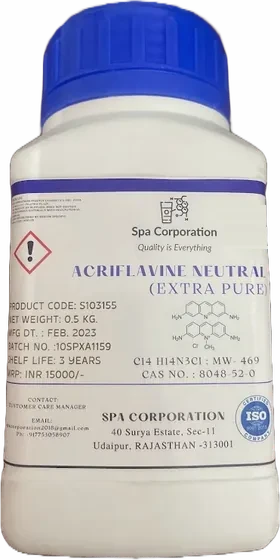
Need a less acidic form? See Acriflavine Neutral, CAS 8048-52-0, which gives a near-neutral solution.
Every batch is released against these limits. Ask for the specification sheet with your quote.
| # | Test | Specification |
|---|---|---|
| 01 | Appearance (colour) | Brown, orange or red to very dark red |
| 02 | Appearance (form) | Powder |
| 03 | Identification, infrared spectrum | Conforms to structure |
| 04 | Identification, fluorescence | Fluoresces on dissolution in water |
| 05 | Solubility | Soluble in 3 parts of water at 20 °C |
| 06 | Loss on drying | Not more than 6.5% |
| 07 | Sulphated ash | Not more than 1.0% |
| 08 | Other acridines | Passes test |
| 09 | Assay | 98.5% to 105.0% |
Our customers are research and testing laboratories, culture media makers, institutions and aquaculture formulators.
A bright fluorochrome that binds DNA. Used in acriflavine–Schiff (fluorescent Feulgen) staining, and to label nuclei and cell walls in plant and fungal tissue.
Histology · cytology · plant scienceA selective agent in enrichment and isolation broths, such as those for Listeria, where it holds back competing organisms in food and water testing.
Culture media makers · food testing labsA well-studied DNA intercalator, used in mutagenesis studies, plasmid curing in bacteria and producing respiratory-deficient "petite" mutants in yeast.
Universities · research institutesAn ingredient in aquarium and hatchery water-care products, and used to protect fish eggs from fungus during incubation.
Hatcheries · ornamental fish tradeLab packs come in sealed, wide-mouth HDPE bottles with the batch number, dates and hazard labels on every container. Other pack sizes are available on request.
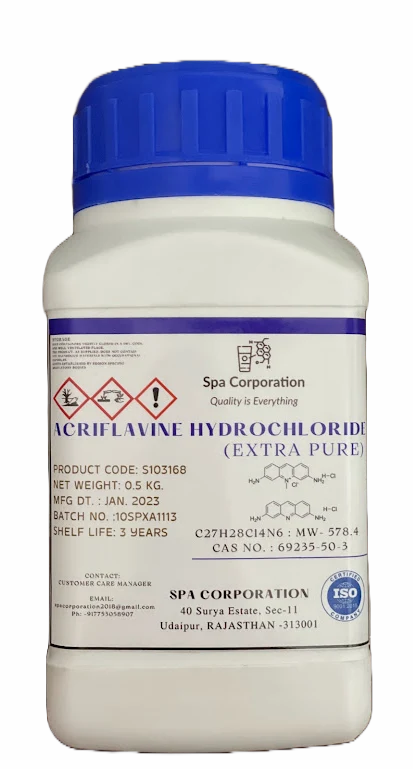
Ask for any of these and we will email them with your quote.
Both contain the same acridine dyes. The hydrochloride carries extra hydrochloric acid, so it gives an acidic solution and dissolves very easily in water. Acriflavine Neutral (CAS 8048-52-0) is the form without that extra acid, and its solution has a pH of about 4.5 to 7.5. Choose the hydrochloride unless your method calls for the neutral form.
250 g, 500 g and 1 kg bottles, and 25 kg bulk packs. Tell us if you need a different size or a repeat schedule.
Send your specification with your enquiry. Our team will confirm which limits we can meet before you order.
Yes. We hold an Import Export Code and supply both domestic and export buyers. Mention the destination country in your enquiry so we can quote the right packing and documents.
Tell us the quantity, pack size and destination. We will confirm price, availability and lead time, and send the documents you need.